

An Unexpected and Useful Omen
Some coincidences may not be coincidental

In autumn of 1986 I broke in my first passport with a trip to Paris, France. Of course I wanted to see the Mona Lisa and Notre Dame. And consume mass quantities of baguettes, croque monsieur and fine French wine. But the main reason I chose Paris was to see my Aunt Dot.
A professor of French Literature at a major Canadian university, Dot frequently traveled to Paris. She even owned a tiny minimalist apartment on Rue Buot in the 13th arrondissement. What better way to experience a foreign country than under the expert guidance of someone who lives there?
One of Dot’s tips was to always order a carafe of the house wine at Parisian bistros and cafes instead of a bottle from the wine list. “It’s cheaper and nearly always as good,” she insisted. My unrefined, 26-year-old palate agreed.
One morning we took a train to visit the historic Chartres Cathedral. Dot adored the Cathedral’s stained glass windows dating back to the 13th century. She timed our visit to coincide with a tour and lecture given by THE Malcolm B. Miller.1 We sat and shivered in the frigid sanctuary on rows of narrow wooden chairs roped together while Malcolm explained the symbolism embedded in the windows’ vibrant colors and intricate designs. They really are quite stunning.
There was something else in the Chartres Cathedral on that cold, October day. Something that would have a profound influence on my life. I was close to it but never saw it.
I didn’t even know it was there.

Ten years later I traveled to San Francisco to attend an international convention with my friend Linda. With a Sunday morning to kill before the convention started, Linda suggested we attend a 10 a.m. worship service at the Grace Cathedral, which happened to be a few blocks from our hotel. I agreed to go, despite the fact that I’d rejected institutional religion as a teenager. I hadn’t stepped foot in a church since.
The art of being a good travel companion is to do what your friend wants to do even if it’s not your jam. If they’re a good travel companion they’ll reciprocate.
With Linda’s help, I managed to follow the 90-minute (!) Episcopal liturgy filled with sitting, standing and kneeling. The chapel was intimate and the sermon was fine. But I felt like an imposter. I didn’t go up for communion.
After the service we exited the chapel. While I waited for Linda to use the restroom I noticed half a dozen people walking slowly and silently on a huge piece of ivory fabric that had been placed on the floor. The fabric was embellished with a cardinal red design that resembled a convoluted path.
A rack filled with tri-fold flyers hung on a nearby pillar. Piqued with curiosity, I took one and learned that the people were walking on a labyrinth.
Goosebumps rose on my forearms. Because it wasn’t just any labyrinth. It was an exact, fabric replica of a labyrinth made of stone found in the floor of…
the Chartres Cathedral.
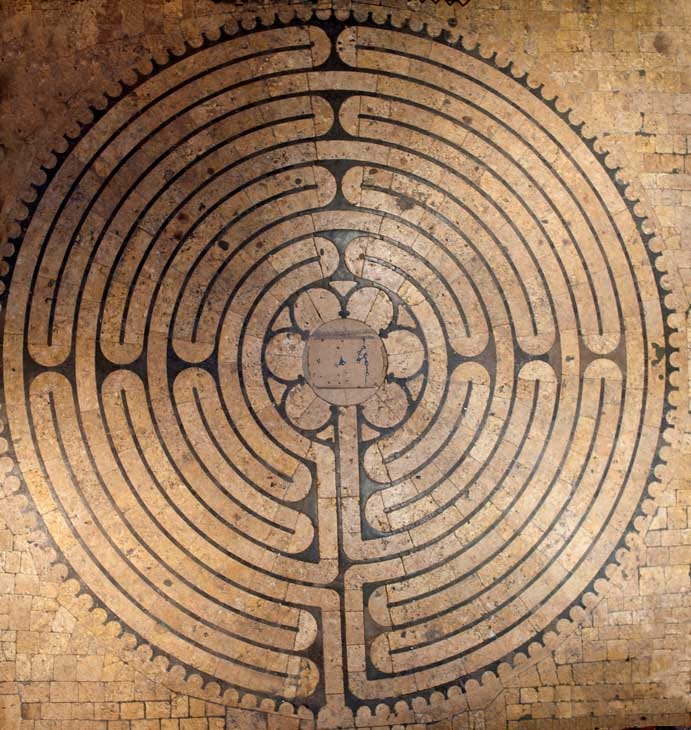
I flashed back to my visit with Aunt Dot 10 years prior. We’d spent hours in the Cathedral. How could I have missed THAT?
The answer was simple. I didn’t see the famous labyrinth because it was covered up. By the rows of roped-together chairs Dot and I sat and shivered upon during Malcolm Miller’s lecture.

Two years later I was researching options for cultural diversity training for the City of Garden Grove. (I was Assistant to the City Manager at the time.) The Orange County Human Relations Commission was convening a series of cultural diversity “discussions.” They would be offered at more than a dozen different locations and were free. But they required a commitment, one session per week for four, consecutive weeks at the same location.
The ONLY option that aligned with my schedule was the one hosted by St. Anselm Episcopal Church in Garden Grove. That’s convenient, I thought. I signed up.
At the first session I felt a strong connection with the parish priest, Father Wilfredo Benitez. A week later, after the second discussion, Father Wilfredo asked if I was affiliated with a church. I confessed I wasn’t—and hadn’t been for almost 25 years. “When was the last time you had a spiritual experience?” he asked.
I told Father Wilfredo about being in the Grace Cathedral, my shock and surprise that the fabric labyrinth the sanctuary had been a replica of the one in Chartres. How I’d been to the Chartres Cathedral, had been in the presence of that labyrinth, literally on top of it, without knowing it. “These experiences happened 10 years apart,” I said. “But I can’t help feeling they’re connected.”
The expression on Father Wilfredo’s face was quizzical. “My wife believes the atrium of this church is crying out for a labyrinth,” he said. “Maybe you’re the confirmation we need.”
Four months later, I took my first walk on a replica of the Chartres labyrinth installed in the atrium at St. Anselm’s. I helped paint that replica. I also joined the church.
Although Father Wilfredo and I have both moved on (him to retirement in Portugal and me to Aldersgate United Methodist Church in Tustin, California), there’s no doubt the Chartres Labyrinth led me back to my progressive Christian faith.
But that’s not the end of the story.
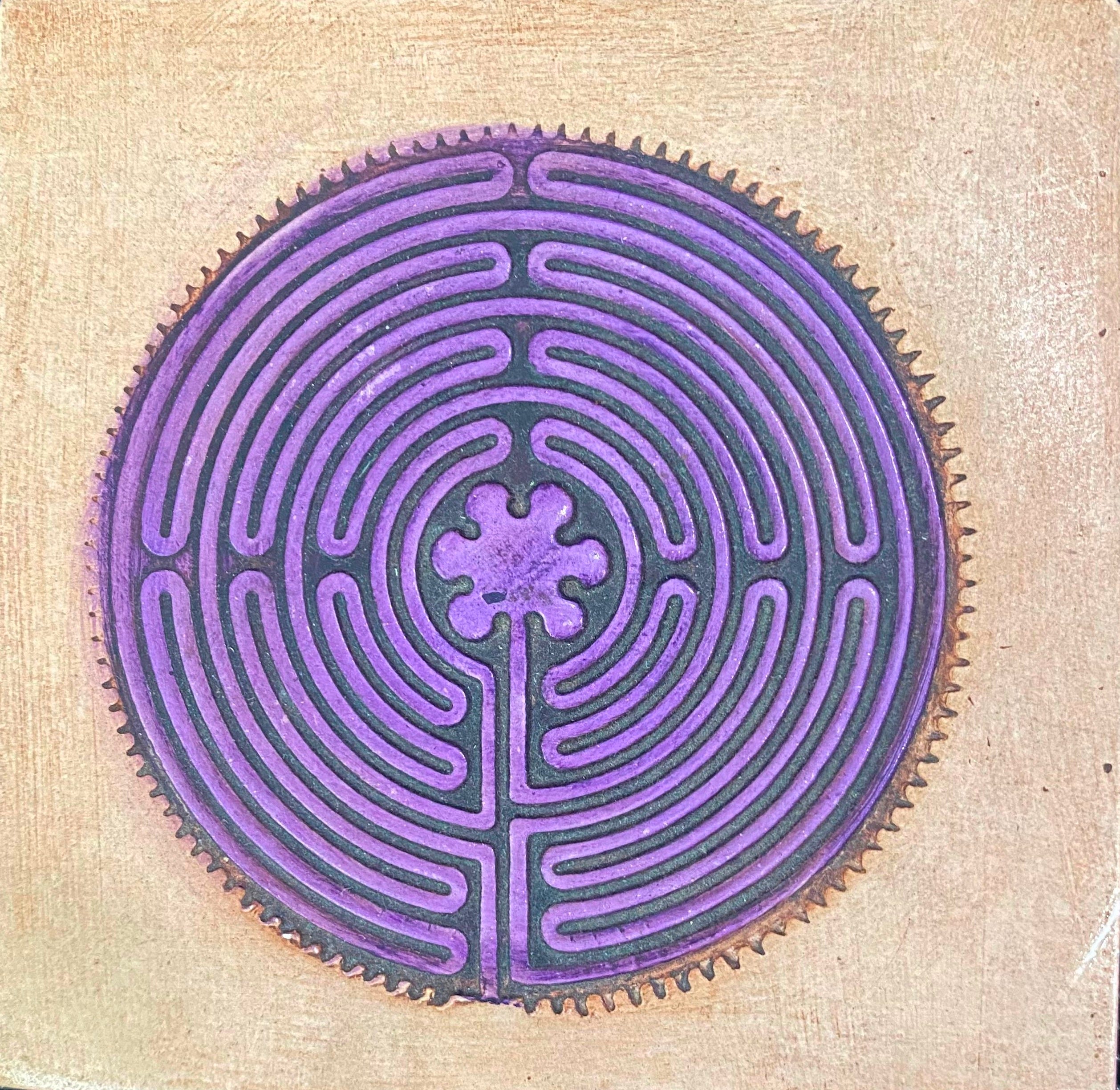
Six years ago, the Chartres Labyrinth reappeared again. This time I happened to be in Taos, New Mexico. It was not my first trip to Taos—my husband and I honeymooned there in 1989 and returned for our 5th anniversary. The Mabel Dodge Luhan house was not on our list of places to visit either time.
What brought me to Mabel’s was a week-long writing retreat. I was excited, but unsure of what to expect. And, similar to my worship experience at the Grace Cathedral, I felt like an imposter. I had no MFA, no formal training in creative writing, just a desire to pen a little poetry. Who was I to call myself a writer?
The labyrinth at Mabel’s was somewhat overgrown with long strands of straw-colored prairie grass. But that familiar path welcomed me like an old friend. “You’ll be okay,” it whispered through the cottonwood leaves. “Take one step at a time.”
I walked the Labyrinth the day the retreat started, and again the following day. On the third day (well, technically the third night), THE IDEA for my historical novel latched onto me like a hungry newborn. It has yet to let go.
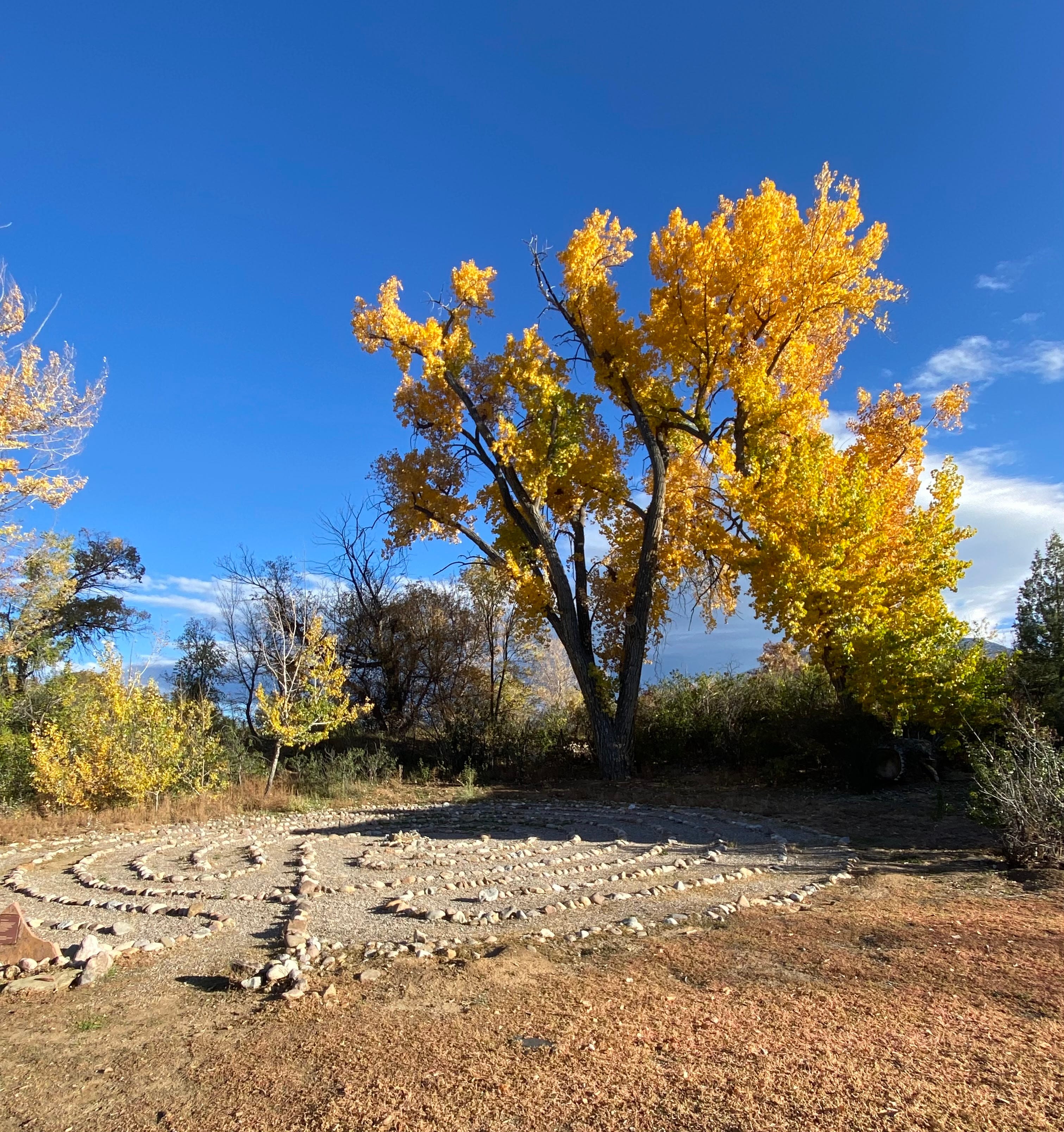
Now I walk the labyrinth each time I return to Mabel’s for another writing retreat. Usually several times over the course of a week. Thanks to my writing friend Pam Bustin, I’ve discovered that my favorite time to walk the labyrinth is in October, early in the morning when it’s dark outside. When the sun has barely begun to rise beyond the Sangre de Cristo mountains.
Sangre de Cristo…“blood of Christ.”2
There’s a holy stillness at that time of day. When there’s no human sound other than the crunch of my hiking boots on the gravel path, timed to the pace of my breath. And when the air numbing my nose is bloody cold.
Like the frigid air inside the Chartres Cathedral.

To be continued…
Malcolm Miller, the preeminent expert on the Chartres Cathedral windows is STILL giving occasional tours (mostly private) at age 90!
According to mountainfieldguide.com, the mountain range bordering Taos was reportedly named in 1719 by Spanish explorer Antonio Valverde y Cosio, who was captivated by the vivid red hues of the mountains at sunrise and sunset.
Lovely post and a wonderful story of finding your way back to faith.
The writing retreat sounds amazing too. Is it open to the public?